The Best Fluffy Pancakes recipe you will fall in love with. Full of tips and tricks to help you make the best pancakes.

In Croatia, lunch is not something you simply fit in between other things. It is the thing. The midday meal called ručak is where the real cooking goes, where families gather, and where the food culture of each region becomes most visible.
A Croatian lunch tells you more about where you are than almost anything else on the plate. Breakfast here is light. Dinner is often whatever was left from lunch. Everything in between is built around the midday table.
Two very different culinary worlds shape what ends up on that table. The coastal regions of Dalmatia and Istria draw from centuries of Mediterranean, Roman, and Venetian influence; olive oil, fresh seafood, and slow fire define almost everything.
Inland, in Zagreb and Slavonia, the food turns to heavier slow-braised meats, paprika, pickled vegetables, and a clear Central European and Ottoman hand in how things are cooked.
The Food Culture Behind a Croatian Lunch
Around 1 pm, the Croatian kitchen reaches its peak. That is when lunch is served, and it is the meal that carries the most weight culturally and nutritionally.
A proper lunch here is not one dish. It moves through courses a starter, a main that has usually been cooking since morning, and a dessert. The portions are generous. The cooking time is long. Neither of these things is seen as excessive.
Slow cooking, local ingredients, and time at the table are not luxuries in Croatian food culture. They are simply how lunch works.
Coastal Croatian Lunch Food Dalmatia and Istria
Along the Adriatic, the pantry is built from what the sea and the land immediately around it produce. Olive oil goes into almost everything. Garlic, capers, white wine, and fresh parsley repeat across dish after dish not because cooks lack imagination, but because these ingredients genuinely work with every protein the coast offers.
The cooking methods here, long hours under embers, slow simmering in open pots, gentle braising are all designed around one idea: patience produces better flavor than heat.
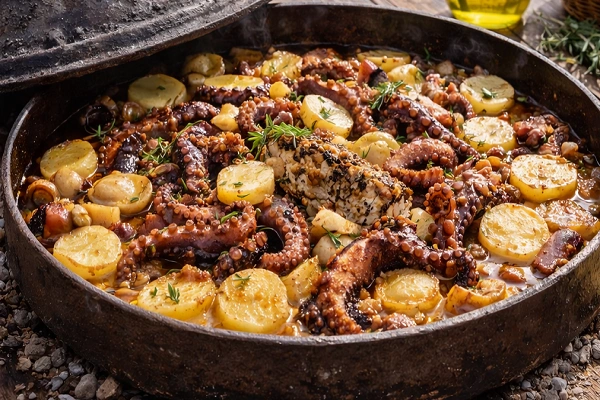
Peka
No other dish in Croatian cooking asks as much of the cook or rewards them as generously. To make peka, meat or seafood is placed into a flat metal dish with potatoes, herbs, and a pour of olive oil.
A heavy, dome-shaped iron lid goes on top. Then hot embers are piled over the lid and left there for two hours or more.
What comes out is hard to explain without having tasted it. The meat, usually octopus or lamb becomes completely tender, with a faint smokiness that no oven can replicate.
The potatoes underneath absorb every drop of fat and cooking juice released during those hours.
Octopus peka and lamb peka taste like entirely different dishes, but both carry the same quality and depth of flavor that only comes from cooking slowly, sealed, with no shortcuts.
Crni Rižot Black Risotto
Before you see the flavor, you see the color. Crni rižot arrives at the table completely black and that alone tells you something about how confident Dalmatian cooking is in its own ingredients.
The black comes from cuttlefish ink, stirred in just before serving. The base is arborio rice cooked with white wine, garlic, and onion, with cuttlefish or squid cooked through the rice itself.
The ink adds a concentrated, briny depth that regular seafood seasoning cannot produce. A light grating of parmesan on top cuts through the richness just enough. The texture is dense and creamy.
This dish has been eaten along the Dalmatian coast since the Middle Ages, when Arab traders first brought rice to the region. After that, it didn’t need to be changed.
Pašticada
Most meat dishes take an hour or two. Pašticada takes two days — and that gap in time is exactly where its flavor lives.
The night before, a whole piece of beef is pierced and packed with garlic, cloves, and carrots, then left to soak overnight in wine vinegar.
The acid slowly breaks down the meat fibers and pulls the aromatics deep into the flesh. By morning, the beef has already changed character entirely.
Then comes the long roast up to five hours with onions, prunes, dried figs, nutmeg, and prošek, Croatia’s native sweet dessert wine. The sauce turns thick, dark, and layered with a sweetness that builds gradually rather than hitting at once.
Pašticada is always finished with homemade potato gnocchi called njoki, made soft enough to absorb the sauce completely. This dish is the centerpiece of Dalmatian lunch food — and has been for generations.
Gregada
On the island of Hvar, the fish stew tradition took its own direction. Where other coastal stews tend toward richness, gregada stays deliberately light.
Fresh white fish, most traditionally scorpion fish or grouper, is cut into large pieces and placed into a pot with potatoes, onions, garlic, capers, olive oil, parsley, and white wine. The pot goes on low heat and stays there, shaken occasionally rather than stirred.
No thickener, cream, or stock is used. The broth builds itself from the fish, the wine, and the oil alone.
The flavor is clean and oceanic. Every cook on Hvar has their own small variation: a touch more wine, a different fish, extra parsley but the restraint is always the same. Gregada does not try to be more than what the sea already gave it.
Buzara
Some dishes are best understood through what they are not. Buzara is not a stew, not a soup, and not a sauce; it is a method of cooking shellfish that produces all three in one pan.
Scampi, mussels, or shrimp go into a wide pan with white wine, garlic, breadcrumbs, and parsley. The breadcrumbs dissolve partially into the liquid, thickening it into something between a broth and a sauce. A red version adds tomatoes for acidity and color.
The Kvarner Bay scampi most commonly used here are among the finest the Adriatic produces. The buzara preparation is intentionally simple so that the shellfish remains the point, not the sauce.
Fresh bread comes with buzara not as a side dish but as a necessary tool the sauce at the bottom of the pan is not meant to be left behind.
Brudet
Along the entire length of Croatia’s coast, this stew goes by slightly different names brudet, brujet, brodet but the logic behind it is always the same.
Several types of fish go into the pot together. Each one serves a different function: one carries flavor, one provides firm flesh, one helps thicken the broth. They simmer together with onions, tomato, vinegar, and spices until the whole thing reduces into something dense and deeply colored.
A splash of vinegar is what separates brudet from other fish stews. It adds a sharpness that cuts through the fat of the fish and keeps the dish from becoming heavy.
Brudet is served over soft polenta or with bread thick enough to hold up to the broth. It was never a refined dish; it came from fishing boats and coastal kitchens that needed to feed people well with whatever came in that morning. That practicality is still what makes it good.
Istrian Lunch Food Fuži, Truffles, and Manestra
Istria shares the Adriatic coastline with Dalmatia but developed its own food identity, shaped by different terrain, different history, and one ingredient that does not exist anywhere else at the same level: the truffle.
The pasta most associated with Istrian lunch is Istarski fuži handmade from egg dough, cut into diamond shapes, and rolled around a thin stick to form a hollow quill. The shape is designed to hold sauce inside the tube as well as outside.
Paired with Istrian truffle sauce, fuži becomes something genuinely exceptional. Truffles here are not a garnish or a luxury addition, they are a staple crop with a serious local industry behind them.
Both black and white varieties are harvested across the peninsula and used generously in pasta, risotto, eggs, and meat dishes throughout the year.
Away from truffles, the most common lunch dish at a traditional Istrian table is manestra, a thick bean soup built on a base of pancetta, garlic, and parsley ground together into a paste.
Beans and smoked pork go in next. The result is dense, warming, and filling in the way that only a slow-cooked one-pot dish can be.
Inland Croatian Lunch Food Zagreb and Slavonia
Cross the coastal mountains and the food changes completely. Olive oil gives way to heavier fats. Fresh seafood gives way to slow-braised pork and beef. The lightness of the Adriatic kitchen is replaced by something altogether more substantial.
The Austrian, Hungarian, and Ottoman influences on inland Croatian cooking are not subtle. They show up in the paprika-heavy stews, the stuffed cabbage rolls, the breaded escalopes, and the rich braised meat dishes that anchor the midday meal across Zagreb and Slavonia.
Štrukli
Ask anyone from Zagreb what their region’s most important lunch dish is, and the answer comes quickly štrukli.
Thin dough is stretched out, spread with a filling of cottage cheese, eggs, and sour cream, then rolled and either boiled in salted water or baked in an oven until golden on top.
Baked štrukli has a light crust with a creamy, yielding interior. Boiled štrukli is softer all the way through and heavier on the palate. Both are finished with a spoonful of sour cream.
The cottage cheese filling has a mild tang that keeps the dish grounded despite its richness. It is the kind of food that feels deeply familiar even the first time you eat it.
Punjene Paprike Stuffed Peppers
Few dishes in Croatian home cooking are as deeply familiar as punjene paprike. Bell peppers are hollowed out, filled with a mixture of minced meat, rice, onion, parsley, salt, and pepper, then stood upright in a pot and covered with tomato sauce.
They simmer on low heat for around 90 minutes. In that time, the pepper walls soften completely and absorb the tomato sauce from the outside while the filling binds together from the inside.
By the time the dish is done, the sauce has thickened and the kitchen carries the smell of slow-cooked tomato and meat throughout.
Punjene paprike are always served with mashed potatoes. Together, they are one of the most complete and straightforward lunch combinations in Croatian cooking.
Sarma Stuffed Cabbage Rolls
Where stuffed peppers use tomato for their cooking liquid, sarma uses something sharper pickled cabbage leaves as both the wrapper and the source of flavor.
The filling is the same minced meat, rice, and spices but wrapped tightly in sauerkraut leaves and packed into a pot with broth. The long, slow cooking draws the sourness of the cabbage into the meat and softens everything into something deeply savory.
That acidity is the point. It cuts through the fat of the meat filling and keeps the dish from feeling too heavy, even though it is substantial.
Sarma is tied to winter and cold months in Croatian food culture. The pickling that preserves the cabbage also defines the dish. It carries the Ottoman influence on Balkan cooking more clearly than almost any other dish on the Croatian lunch table.
Cobanac Slavonian Meat Stew
From eastern Croatia’s Slavonia and Baranja region comes the most boldly spiced dish in the entire Croatian lunch tradition.
A slow-cooked stew of beef, pork, and sometimes game meat goes into the pot with potatoes, carrots, and onions, seasoned heavily with both sweet red paprika and hot paprika. It cooks over an open fire until the meat falls apart and the broth turns thick and deeply red.
Paprika in Slavonian cooking is not a finishing spice. It is a fundamental ingredient the same way it functions in Hungarian cuisine, which influenced this region directly and significantly over centuries.
Cobanac does not try to be subtle. The heat builds slowly, the color is dramatic, and the portions are always generous.
It is exactly the kind of food that this agricultural region has always needed filling, warming, and built to last through a long afternoon.
Zagrebački Odrezak Zagreb Schnitzel
Zagreb’s answer to the Central European schnitzel tradition has one difference that changes everything that is inside.
A thin veal escalope is stuffed with ham and cheese before being breaded and deep-fried until the coating is completely golden and crispy. When cut open, the melted cheese runs out from the center.
The contrast between the crunchy exterior and the soft, savory filling is what makes zagrebački odrezak work as a dish.
It is clearly related to the Italian cordon bleu, but the Croatian version developed its own local character through the specific choice of filling and the way it is served simply, without heavy saucing.
Starters and Desserts in a Croatian Lunch
Before the main course arrives on the coast, the table usually holds pršut air-dried cured ham made without preservatives, relying entirely on sea air and dry conditions to cure the pork over a minimum of 12 months.
It arrives sliced thin alongside Pag cheese, a hard sheep’s milk cheese from the island of Pag aged up to 18 months.
The sheep on Pag graze on salty, herb-covered pastures. That diet gives the milk a sharpness and minerality that the cheese carries all the way through to the finished wheel. The texture is close to Parmesan but the flavor is its own.
Octopus salad salata od hobotnice is another coastal starter worth knowing. Boiled octopus is dressed with olive oil, lemon juice, capers, onion, and parsley. It is bright and acidic, a clean contrast to whatever comes after it.
For dessert, Dalmatia has rožata, a baked custard pudding that looks similar to crème caramel but tastes entirely different. The flavoring comes from Dubrovnik rose liqueur called rozalin, which gives the custard a floral aroma and a gently perfumed sweetness. Versions made with vanilla extract are not the same dish.
In Zagreb and the north, desserts move toward walnut rolls (orahnjača), honey-sweetened pastries, and cream-filled layered cakes. In coastal regions, almond biscuits and fig-filled cookies are more commonly shaped by the Mediterranean climate and the ingredients it produces naturally.
What Makes Croatian Lunch Food Distinct
There are no complicated techniques at the center of Croatian lunch food. No elaborate plating, no reductions built from a dozen components. What sits at the center instead is something harder to manufacture quality ingredients and the willingness to give them time.
Peka needs two hours under embers. Pašticada marinates overnight and braises for five hours. Cobanac simmers over an open fire until it is ready, not until the clock says so. These timelines are not negotiable and they are not incidental. They are the cooks.
The ingredients carry their own weight too. Istrian olive oil, cold-pressed in small family groves, has a grassy, peppery character that changes the flavor of everything it touches. Pag lamb, raised on aromatic herbs in salty coastal air, has a lean, pale pink flesh that no inland-reared animal produces.
Ston oysters from the Pelješac peninsula and Kvarner scampi are prized because of the specific water they grow in and the specific things they feed on. The geography is not background detail, it is an active ingredient.
Croatian lunch food is also stubbornly regional. A bowl of manestra from Istria shares nothing with a plate of cobanac from Slavonia. Štrukli from Zagreb has no relation to peka from Dalmatia. Each dish belongs somewhere specific and reflects the land, the history, and the food culture of that exact place.
That specificity, the fact that each dish is genuinely rooted rather than broadly generic is what makes Croatian lunch worth understanding as a food tradition in its own right.