The Best Fluffy Pancakes recipe you will fall in love with. Full of tips and tricks to help you make the best pancakes.

Walk through any street in Istanbul at eight in the morning and you will notice something immediately. People are not rushing to coffee shops.
They are stopping at small carts, handing over a few lira, and walking away with a warm, sesame-covered ring of bread. No apps, no menus, no decisions to make. Just simit, every single day, like it has always been.
That is the thing about Turkish snacks. They are not trendy. They did not show up on a food blog five years ago and suddenly became popular.
Most of them have been around for centuries, and the people eating them today are eating the same things their grandparents ate. That kind of enduring power means something.
This guide covers the most well-known Turkish snacks, what they are, where they come from, and what makes each one worth knowing about.
1. Simit
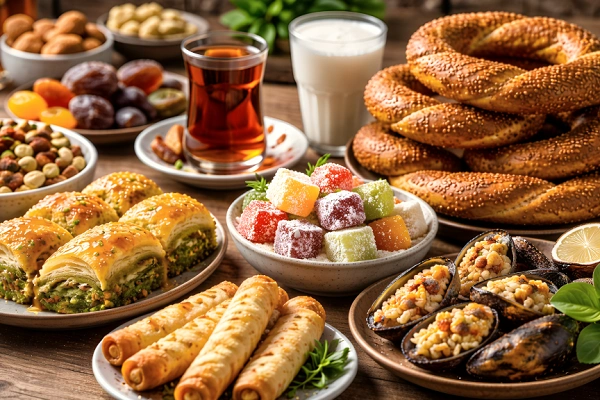
Simit is a ring-shaped bread covered in sesame seeds, baked until the outside is crispy and the inside stays soft and slightly chewy. It is sold from red carts on almost every street corner in Turkey, and the vendors often call out to passersby to let them know the batch is fresh.
Archival records confirm that simit has been produced in Istanbul since 1525. Court records dated 1593 show that Ottoman authorities officially standardized the weight and price of simit — which tells you just how embedded it already was in daily life by that point.
A 17th-century traveler documented that there were 70 simit bakeries operating in Istanbul during the 1630s. Academic research also places simit’s roots in Turkish culture as far back as the 14th century.
The bread itself is made from flour, yeast, salt, sesame seeds, and pekmez — a thick, dark syrup made from boiled grape juice. The pekmez dip before baking is what gives simit its color and its particular crunch. It looks something like a bagel, but the two are not the same.
Bagels are boiled before baking; simit goes straight into the oven after the molasses dip, which makes it lighter and crispier.
One detail that says a lot about simit’s place in Turkish culture: the price of simit is regularly used as an informal measure of inflation in Turkey. When the cost of a simit goes up, people notice and talk about it.
2. Leblebi
Leblebi is roasted chickpeas. That description makes it sound simple, and the ingredient itself is, but the process of making leblebi properly is not. The chickpeas go through multiple stages — soaking, tempering, boiling, resting, roasting, and sometimes dehulling — before they become the crispy, nutty snack sold in Turkish markets.
The word leblebi comes from Persian. It is considered one of Turkey’s oldest traditional snack foods, with production historically concentrated in cities like Çorum, Denizli, Kütahya, and Gaziantep. Çorum still holds its reputation as the leblebi capital of the country.
During the Ottoman period, leblebi moved through trade routes into the Middle East, North Africa, and parts of Europe — affordable, portable, and shelf-stable, which made it practical for long journeys.
There are a few different varieties. Sarı Leblebi is double-roasted and dehulled, giving it a yellow color and a more intense crunch. Beyaz Leblebi is lightly roasted and keeps its hull, making it milder. Sakız Leblebi has a chewier texture. Each has its own regional following inside Turkey.
3. Gözleme
Gözleme is a flatbread snack made by filling thin yufka dough, folding it over, and cooking it on a flat iron griddle called a sac. The fillings vary — white cheese and spinach is probably the most traditional combination, but minced meat, potatoes, and mushrooms are all common.
It was originally a breakfast food or a light afternoon snack, made at home on griddles over wood fires. Today it has moved into street food territory and can be found across Turkey at market stalls, roadside spots, and cafes.
The regional differences are real — coastal areas tend toward cheese and herb combinations, while inland Anatolia leans heavier on meat fillings.
4. Börek
Börek occupies a particular place in Turkish food culture. It is not really street food and it is not really restaurant food — it is home food, the kind of thing associated with mothers and grandmothers and Sunday mornings.
Made from layers of yufka or phyllo dough filled with cheese, spinach, or meat, then baked or fried, börek exists in dozens of regional variations across Turkey.
Sigara böreği is the version most commonly seen as a snack or appetizer — thin, cigar-shaped rolls of fried dough filled with feta cheese and parsley. The name simply means cigarette börek, referring to the shape. They are eaten hot and are the kind of thing that disappears from a plate faster than expected.
5. Midye Dolma
In Istanbul and Izmir, mussels stuffed with spiced rice are sold by street vendors from large trays, usually in the evenings near waterfronts. The mussels are filled with a mixture of rice, pine nuts, currants, cinnamon, and allspice, then served cold with a squeeze of lemon.
The way to eat them is straightforward. You open the shell, squeeze lemon over the mussel, and use the empty half of the shell to scoop it into your mouth. Most people buy several in a row, standing at the vendor’s cart, and the vendor keeps count for you.
6. Baklava
Baklava is layers of paper-thin filo pastry filled with ground pistachios or walnuts, baked, and then soaked in sugar syrup. It is sweet, rich, and dense — the kind of thing eaten in small pieces, usually with Turkish tea or coffee.
The origin of baklava is historically disputed. Ancient Assyrian cultures made honey-and-nut dishes as far back as the 8th century BC, and various layered pastry traditions existed across Persia, Byzantium, and Central Asia.
However, baklava in the form recognizable today took shape in the Ottoman Empire, with the earliest known written reference to baklava by name appearing in a 15th-century poem. By the 16th century it had become a food of renown across the empire, prepared by specialist pastry chefs in palace kitchens.
Gaziantep baklava was granted EU Protected Geographical Indication status in December 2013 — meaning only baklava produced in that region using its established methods can officially carry that designation. This makes it the first Turkish product to receive EU protected status of this kind.
Baklava is not only an everyday snack. It is made for weddings, prepared for Eid, and given as gifts. The sweet itself carries a certain weight in Turkish social life that goes beyond just eating something good.
7. Lokum
Lokum — called Turkish delight outside of Turkey — is a chewy sweet made from starch and sugar, dusted with powdered sugar or shredded coconut. The flavors vary: rose water, mastic resin, lemon, and pistachio are among the most traditional.
It has been produced in Turkey for centuries and was a fixture of the Ottoman court. Western audiences became familiar with it largely through C.S. Lewis, who made Turkish delight a central detail in The Lion, the Witch and the Wardrobe.
In Istanbul, old lokum shops that have been operating for generations still make it the same way — by hand, in copper pots, without shortcuts.
8. Dried Fruits and Nuts
Turkey is one of the world’s largest producers of hazelnuts, dried apricots, pistachios, figs, and walnuts. This is not background trivia — it directly explains why dried fruits and nuts are such a natural part of everyday snacking there. These are not imported specialty items. They are grown locally, they are fresh, and they are inexpensive.
According to official data from the Food and Agriculture Organization of the United Nations, Turkey accounts for approximately 70 percent of global hazelnut production and 82 percent of global hazelnut exports — by a very significant margin over any other country.
Most of this production comes from provinces along the Black Sea coast, with Giresun considered the hazelnut capital of the country. Malatya is the center of dried apricot production and supplies a significant portion of the world’s supply.
Gaziantep pistachios carry their own EU Geographical Indication protection, distinguishing them from pistachios grown elsewhere.
A bag of mixed nuts and dried fruits bought from a Turkish market is not the same thing as the mixed nuts sold in airport shops. The difference in quality is noticeable.
9. Kestane
In winter, roasted chestnut carts appear on the streets of Turkish cities. The chestnuts are roasted on small charcoal grills, scooped into paper cones or bags, and sold warm. They smell particularly good in cold air, which is probably part of why they have become so associated with Turkish winters.
There is nothing complicated about kestane. It is just chestnuts, roasted until soft inside and slightly charred outside. But buying a bag and eating them while walking through a cold Istanbul evening is one of those things that is difficult to forget.
10. Çiğ Köfte
Çiğ köfte translates literally to raw meatballs, but the version sold today contains no meat. It is made from fine bulgur wheat, tomato paste, onion, and a heavy hand of spices, kneaded together until the mixture becomes dense and slightly sticky.
It is typically served wrapped in thin lavash bread with lettuce, lemon, and pomegranate sauce.
Dedicated çiğ köfte shops are found all over Turkey — in shopping centers, near universities, on busy pedestrian streets. It is fast, cheap, filling, and entirely plant-based, which has made it consistently popular across different age groups.
11. Kumpir
Kumpir is a baked potato, but describing it only as that undersells it considerably. A large potato is baked until the inside is fully soft, then split open and mixed vigorously with butter and kaşar cheese until the inside is creamy. From there, a long row of toppings is available — corn, pickles, sausage, olives, coleslaw, and more.
The Ortakoy neighborhood in Istanbul has an entire stretch of kumpir stalls and has become the most well-known spot for it in the country. The potatoes used are large, the toppings are generous, and eating one while looking out at the Bosphorus is a reasonably specific Istanbul experience.
12. Pide and Lahmacun
These two are not quite snacks in the traditional sense, but they function that way in Turkish daily life — quick, affordable, eaten on the go or at a simple table without much ceremony.
Pide is a boat-shaped flatbread baked in a stone oven with toppings pressed into the dough: minced meat, cheese, eggs, or spinach depending on the variety.
Lahmacun is thinner and crispier, with a layer of spiced minced meat spread across the entire surface. It is eaten rolled up, usually with fresh parsley and a squeeze of lemon inside.
Both are found in dedicated restaurants and street stalls throughout Turkey, and both are typically accompanied by Ayran.
13. Ayran
Ayran is yogurt thinned with water and salted. It is cold, slightly sour, and refreshing in a way that pairs well with almost everything on this list. It is served alongside kebabs, pide, lahmacun, simit, and most other Turkish foods. In summer especially, it is everywhere.
It is not a complicated drink, but it works. The saltiness and the cold temperature make it a practical companion to spiced or heavy foods, and it has been part of Turkish food culture long enough that it would be strange to eat most of these snacks without it.
Final Thoughts
Turkish snacks did not develop in isolation. They came out of centuries of Ottoman culinary culture, geographic variety, and trade connections stretching from Central Asia to the Mediterranean.
The chickpeas in leblebi, the pistachios in baklava, the grapes that become pekmez for simit — these ingredients are native to or historically rooted in Anatolian land.
That context does not change how these snacks taste, but it does explain why they have lasted. They are not novelties. They are the result of practical, cumulative knowledge about ingredients, preparation, and what people actually want to eat.