The Best Fluffy Pancakes recipe you will fall in love with. Full of tips and tricks to help you make the best pancakes.

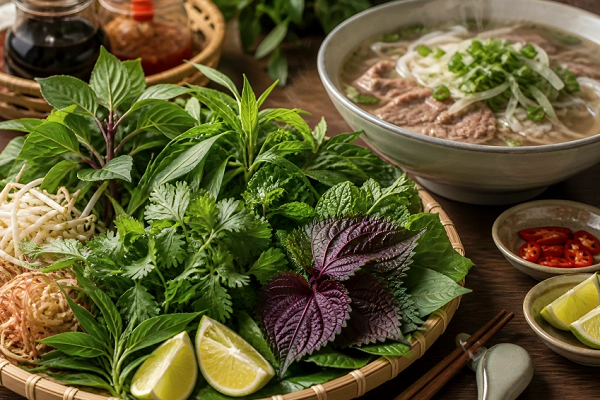
If you have ever sat down at a Vietnamese restaurant and noticed a big plate full of fresh green leaves placed right next to your bowl of soup, that plate has a name. It is called rau thom. And once you understand what it is, you will never look at Vietnamese food the same way again.
What Does Rau Thom Actually Mean?
The word itself is simple. In Vietnamese, “rau” means leafy greens or vegetables, and “thom” means fragrant or aromatic. Put them together and you get “fragrant greens” which is exactly what they are.
But rau thom is more than just a word. It is a concept. It represents the entire collection of fresh, aromatic herbs that are used across Vietnamese cuisine every single day. These are not herbs that get buried in a sauce or cooked away in a stew. They are served fresh, right at the table, so every person can use them however they like.
This is something quite unique about Vietnamese food culture. The meal is not fully finished in the kitchen. The diner completes it themselves picking up a leaf here, tearing off a sprig there, dropping it into the bowl or wrapping it around a piece of meat. Rau thom gives that freedom.
How Is Rau Thom Served?
Typically, a rau thom platter arrives as a side dish alongside the main meal. It is a wide plate or basket loaded with different types of fresh herbs, sometimes whole stems, sometimes individual leaves. You will often also find a few slices of lime or lemon sitting on the same plate.
The herbs are completely optional to use. Nobody forces you to add them. But most people do, because they genuinely transform the dish adding brightness, freshness, a little heat, or a cooling effect depending on which herb you pick.
This style of eating, where people customize their own bowls, reflects something deeper in Vietnamese culture. Food is personal. Everyone’s bowl should taste exactly the way they want it to.
The Most Common Herbs Found in Rau Thom
Cilantro
Cilantro is probably the most widely used herb in all of Vietnamese cooking. It has soft, delicate light-green leaves with a fresh and slightly citrusy flavor. You will find it sprinkled on top of soups, mixed into spring rolls, and used as a finishing garnish on almost every kind of dish.
It is worth knowing that cilantro is one of those herbs that people either love completely or dislike strongly. Some people find its smell and taste overpowering. In Vietnam, however, it is as natural as salt and pepper, a basic part of almost every meal.
Thai Basil (Húng Quế)
Thai basil looks similar to regular basil but it tastes quite different. It carries notes of anise and a faint hint of cinnamon, which makes it a perfect match for rich, spiced broths. It is especially well-known as a companion to Southern-style pho, where its slightly sweet, warm flavor balances the deep beef broth beautifully.
Vietnamese Coriander (Rau Răm)
This herb is easy to recognize by its narrow, spear-shaped leaves that often have a dark, feather-like marking running down the center. Its flavor is hard to describe in a single word; it starts with a cilantro-like herbal note and then finishes with a sharp, slightly spicy kick at the back of the tongue.
Rau ram is a common pairing for salads, noodle dishes, and certain Vietnamese delicacies. It is one of those herbs where a little goes a long way.
Perilla (Tía Tô)
Perilla is one of the most visually striking herbs on the rau thom plate. The leaves are green on one side and purple or reddish-purple on the other, making them immediately stand out. Its flavor is complex somewhere between mint, licorice, and lemon all at once.
It works particularly well alongside rich, fried dishes like Vietnamese sizzling pancakes (banh xeo) and grilled pork noodle bowls (bun cha). It also appears in rice porridge and certain noodle soups.
Spearmint (Húng Lủi)
Spearmint is the milder, gentler mint. It has a fresh, slightly sweet flavor without the sharp, biting intensity of peppermint. You will find it in fresh spring rolls, salads, and cold noodle dishes. It adds a cooling effect that works really well on a hot day with a light, fresh meal.
Fish Mint (Diếp Cá)
This herb might have the word “mint” in its name, but it tastes nothing like mint. It is called fish mint for a reason it has a strong, pungent, fishy smell and flavor that is quite unlike anything else. People tend to have a very strong opinion about it in one direction or the other.
Despite its unusual smell, it has a loyal following among those who grew up eating it. It pairs well with grilled meats and bold-flavored dishes where its sharpness does not feel out of place.
Dill (Thì Là)
Dill is interesting because it breaks the main rule of rau thom most herbs are eaten completely raw, but dill in Vietnamese cooking is typically cooked. It is most closely associated with a famous Hanoi dish called Cha Ca La Vong, where fish is grilled and then pan-fried in a generous amount of dill along with spring onions. The result is fragrant, golden, and deeply satisfying.
Outside of that dish, dill also appears in certain soups and fish preparations, always bringing its distinctive fresh, slightly anise-like aroma.
Rau Thom and Pho An Inseparable Bond
If there is one dish that most people associate with Vietnamese herbs, it is pho, the country’s most iconic noodle soup. And the connection between pho and rau thom is real and important.
A bowl of beef pho, with its deep broth infused with star anise, cinnamon, and charred ginger, would feel incomplete without fresh herbs. Cilantro is often added in the kitchen just before the bowl is served. Then at the table, diners tear in leaves of Thai basil, add a squeeze of lime, and toss in whatever herbs they prefer.
This is not just flavoring. It is a ritual. The herbs bring freshness to contrast the richness of the broth. They add color and aroma. They make the bowl feel alive.
For chicken pho, the herb choices tend to be lighter mint is a favorite. The gentler broth does not need as much contrast, so the herbs play a more subtle supporting role.
Why Vietnamese Cooking Relies So Heavily on Fresh Herbs
There is a philosophy behind rau thom that goes beyond flavor. Vietnamese cuisine has always valued balance between richness and freshness, between warm and cool, between heavy and light. Fresh herbs are the tools that create this balance at every meal.
A plate of grilled pork can be heavy and intense. But wrap it in a lettuce leaf with some rice noodles, a leaf of perilla, and a sprig of mint, and suddenly it feels light and complete. The herbs do not compete with the main dish. They complete it.
This balance has also played a role in Vietnamese wellness traditions for a very long time. Before modern medicine became widely available, fresh herbs were everyday remedies.
People brewed them into teas for colds, added them to congee for digestive issues, or simply ate them regularly as part of a healthy diet. That connection between herbs and health still exists in Vietnamese households today.
North vs South Does Rau Thom Differ Across Vietnam?
Yes, and the differences are noticeable. Vietnamese cuisine is not uniform across the country. The food of Hanoi in the north is quite different from the food of Ho Chi Minh City in the south, and the herbs reflect that.
In the south, herb platters tend to be larger and more generous. You might find bean sprouts, banana blossoms, and water spinach sitting alongside the herbs. The southern palate enjoys a wider variety of flavors and textures on the table at once.
In the north, rau thom platters are generally simpler. Fewer herbs, more focused. A classic Hanoi pho might only need mint or Vietnamese balm on the side, nothing more. The restraint is intentional.
In the central regions, particularly around Hue, the word “rau thom” sometimes refers to a specific type of herb rather than the general concept. Regional identity runs deep in Vietnamese cooking, and even the language around herbs reflects it.
Can You Grow Rau Thom Herbs at Home?
Many of the herbs found in a rau thom platter are surprisingly easy to grow at home, even outside of Vietnam.
Spearmint, Vietnamese coriander, and Thai basil all grow well in pots on a sunny windowsill or balcony. Mint especially tends to spread quickly and can become quite vigorous once established. Vietnamese coriander enjoys warm, humid conditions and grows happily in moist soil.
Garlic chives are perhaps the easiest of all; they grow almost anywhere, need very little attention, and produce seeds that spread on their own. Once you have a patch of garlic chives growing, you will rarely run out.
For those who cannot grow their own, most Asian grocery stores carry fresh Vietnamese herbs. In cities with Vietnamese communities, the selection is usually excellent.
A Few Things People Often Get Wrong About Rau Thom
It is not just garnish. Many people from outside Vietnamese food culture see the herb plate and assume it is decorative like parsley on the side of a plate in a Western restaurant. It is not. The herbs are meant to be eaten and they genuinely change the flavor of the dish.
Not every herb suits every dish. Just because all the herbs are on the same plate does not mean they all pair equally well with everything. Fish mint, for example, is very specific in where it works. Thai basil belongs in certain soups but might overwhelm a delicate chicken dish. Learning which herbs go where is part of understanding Vietnamese food more deeply.
Fresh is non-negotiable. Rau thom herbs are not meant to be dried or preserved. They are eaten raw and fresh because their flavor and aroma come from volatile compounds that disappear quickly after the herb is dried. A dried version of Vietnamese coriander or perilla would taste like a completely different thing and not in a good way.
Final Thoughts
Rau thom is, at its core, a beautiful idea. It says: here is your food, and here are the tools to make it exactly yours. No two people at the same table will have the same bowl. Everyone adjusts, adds, tastes, and finds their own balance.
That is what makes Vietnamese cuisine so quietly special. The kitchen starts the meal. You finish it.
Next time you see that green plate arrive alongside your bowl of pho or your spring rolls, do not push it aside. Pick up a leaf, smell it, try it. You might discover your new favorite flavor one you never expected to find in a pile of fresh herbs on a simple white plate.

Rachel Bradley is a food writer and recipe developer with a love for home cooking and global flavors. She has spent years testing recipes in her kitchen, exploring everything from quick weeknight meals to traditional dishes from around the world. Her goal is simple — make great food accessible to everyone.