The Best Fluffy Pancakes recipe you will fall in love with. Full of tips and tricks to help you make the best pancakes.

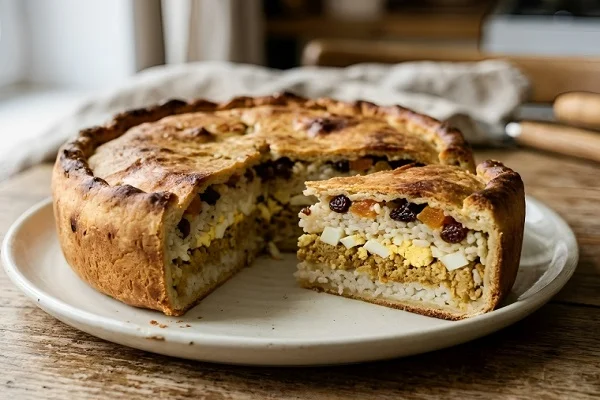
Gubadia is a closed, round pie from Tatarstan, and its filling is built, not mixed. Rice, kort, chopped hard-boiled egg, more rice and dried fruit go in one layer at a time, with melted butter poured over each. Cut a slice and you can see the stack.
Kort is the ingredient to understand first. It is a sweet, crumbly curd with a taste close to baked milk, and it gives the pie its particular flavor. It is also the one ingredient that can stop you from making this pie at all.
The name, and where the pie is from
In Tatar the name is written гөбәдия (göbädiä in Latin script). Russian writes губадия and pronounces it roughly “gubadya”. English spellings include gubadia, gubadiya and gubaidia, and all of them mean the same pie.
Gubadia is best documented in Volga Tatar cuisine. It is recorded in Tatarstan’s cultural heritage catalogue, described by the nineteenth-century Tatar scholar Kayum Nasyri, and included in Yunus Akhmetzyanov’s 1969 collection of Tatar dishes.
It is also made in neighbouring Bashkortostan and Chuvashia. Some English-language sources list it under Crimean Tatar cuisine, but no Crimean-specific documentation turned up in the research for this article. What follows is about the Volga Tatar pie made with kort.
It started with meat
According to Tatarstan’s heritage catalogue, gubadia began as a meat dish. Nasyri describes minced meat chopped fine, with kort laid over it, then grated boiled eggs and butter. Akhmetzyanov’s definition adds rice, steamed raisins (or dried apricots or prunes) and beef cooked with onion.
The sweet version is what most people eat now. It is what bakeries in Tatarstan sell, in full size and as small individual pies. The meat version has become rare enough that many people don’t know it existed.
Even the sweet pie varies. Some cooks skip the dried fruit, since kort already brings a little sourness. Others skip the egg. The dough may or may not contain yeast. Akhmetzyanov specified only its weight, 1 to 1.2 kg per pie, and said it should be rich.
Kort
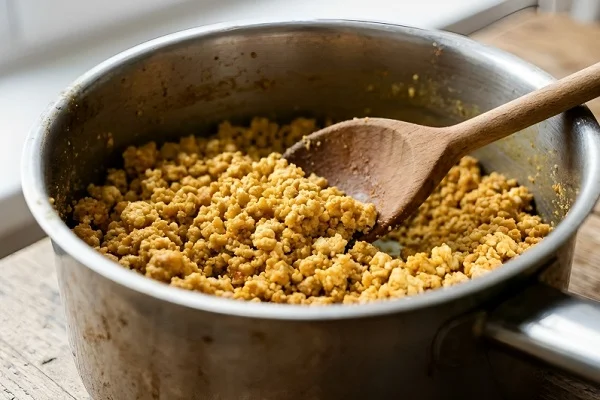
Kort is dry, crumbly and sweet. It is made by cooking curd with sugar and ghee until the moisture evaporates, which leaves a golden to orange mass. Russian cooks also call it “red curd”.
At home it is usually made from fermented milk: ryazhenka (baked fermented milk), katyk (a Tatar soured milk, close to thin yogurt) or kefir.
The word comes from the same Turkic root as “dry”. That root also names the hard, salted yogurt balls sold across Central Asia as kurt or qurut.
They are a different product and don’t belong in gubadia. If the package says “kort” or “kurt,” take a crumb and taste it. You want it to be sweet and buttery, and you don’t want it to be sharp and salty.
Kort is made commercially in Tatarstan, but it is hard to find elsewhere. Your best chance is a shop that stocks Russian or Tatarstan dairy. Otherwise you will need to make it, which is slow but not difficult (instructions in the recipe).
There is no simple substitute that reproduces traditional kort exactly. You can make the pie without kort, but the flavor will not be the same.
Why the layers are counted
Gubadia is a wedding pie, served after the nikah. The bride traditionally made it, and a good pie meant even layers, baked through but still crumbly.
The number of layers was traditionally odd, with some accounts giving five to nine. It stood for the days the groom could stay in the bride’s parents’ house after the wedding.
The groom’s father cut the first slice and placed a coin on it as a symbolic payment for the pie.
One account notes that baking such a pie evenly in a village oven was difficult. Everyday gubadia isn’t held to the layer count, but the recipe below uses five layers.
Gubadia recipe: one 24 cm pie
This is the sweet version with five layers and a yeast-free butter dough. It is sliced into 8-10 pieces. Tatar cooks vary the proportions freely, so treat these quantities as a working home version.
Equipment: a 24 cm springform tin at least 5 cm deep (a deep cake tin or ovenproof skillet also works), baking parchment, and a baking tray to catch any butter.
Ingredients
Dough
- 400 g plain (all-purpose) flour, about 3¼ cups
- 115 g cold unsalted butter, diced (½ cup, 1 US stick)
- 1 large egg plus 1 egg yolk
- 120 ml milk (½ cup)
- 20 g sugar (1½ tbsp)
- ½ tsp salt
Kort layer
- 300 g kort
- 100 ml milk (scant ½ cup)
- 100 g sugar (½ cup), or 50 g if the kort is already sweetened. Taste first.
Rest of the filling
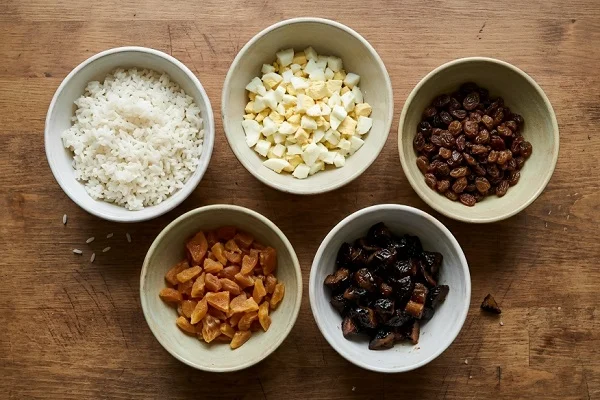
- 100 g long-grain rice (½ cup), cooked to about 300 g
- 2 tbsp sugar, for the upper rice layer
- 5 large eggs
- 150 g raisins (1 cup)
- 6 dried apricots and 6 pitted prunes, about 100 g together
- 250 g unsalted butter, melted (1 cup plus 2 tbsp), plus about 20 g to grease the tin
The butter amount is generous on purpose, because the filling should be moist and rich.
Making your own kort
Start a day ahead. You need about 2 litres of full-fat ryazhenka, katyk or kefir, 5 tbsp sugar and 1 tbsp ghee or butter.
- Pour the ryazhenka, katyk or kefir into your widest heavy pan. Boil it hard until the liquid has cooked off and thick curds remain. This takes well over an hour for 2 litres.
- Lower the heat and stir constantly. The mass thickens like semolina porridge, then dries into granular lumps resembling baked cottage cheese. Don’t leave it, because it catches easily.
- Stir in the sugar and ghee, cook a couple of minutes more, then cool. Crush any large lumps.
- Weigh it. You need about 300 g. If you have under 250 g, make a thinner kort layer rather than topping it up with another cheese.
Method
Kort paste
Crumble the kort into a saucepan with the milk and sugar. Warm over low heat, stirring, until it becomes a thick, spoonable paste, about 5 to 10 minutes. Cool completely.
Rice
Rinse it and boil in salted water until just tender with a little bite, about 8 to 10 minutes. Drain well and spread on a tray so it steams dry. The grains should be dry and separate.
Eggs
Boil for 10 minutes, cool, peel, and chop finely or grate coarsely.
Fruit
Pour boiling water over the raisins, apricots and prunes and leave for 10 to 15 minutes. Drain very well and pat dry. Chop the apricots and prunes to about raisin size and mix everything together.
Dough
Mix the flour, sugar and salt. Rub in the cold butter until the mixture looks like coarse crumbs. Add the egg, yolk and milk and mix, then knead briefly until smooth.
If it would not come together add milk a spoonful at a time. Wrap and chill for 30 minutes. Cut off one-third for the lid.
Prepare the tin
Heat the oven to 180°C (160°C fan). Grease the tin and line the base with parchment. Divide the melted butter into seven roughly equal portions of about 35 g: one for the base, one for each of the five layers, one for the lid.
Line the base
Roll the larger piece into a circle about 36 cm across and 4 to 5 mm thick. Lay it in the tin, press it into the corners and let the excess hang over the rim. Brush the base with one portion of butter.
Layer
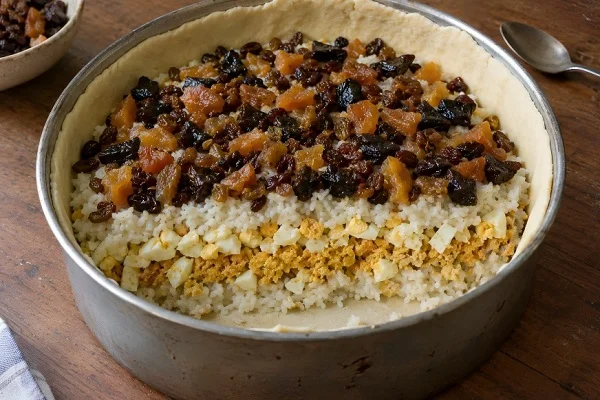
Spread each layer evenly to the edge and drizzle a portion of butter over it before adding the next:
Add one-third of the rice to cover the base and absorb the kort’s moisture.
the kort paste
the chopped eggs
the rest of the rice, mixed with 2 tbsp sugar
the dried fruit
Close
Roll the smaller piece to about 26 cm. Fold the overhanging dough in over the filling and brush the folded edge with cold water.
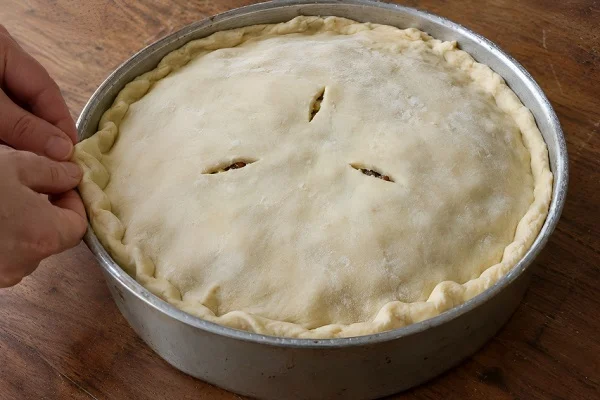
Set the lid on, press all around to seal, then trim and crimp. Cut three small slits for steam, brush with the last portion of butter, and stand the tin on the baking tray.
Bake
Use the lower-middle shelf for 50 to 60 minutes, until the crust is deep golden and firm. The filling is already cooked, so the oven only has to bake the dough through.
If the lid darkens before the sides are done, cover it loosely with foil. Rest in the tin for 20 to 30 minutes before releasing the springform.
Serving
Serve in wedges, warm or at room temperature, with tea. In Tatarstan, gubadia is eaten with a spoon from a dessert plate. Refrigerate leftovers promptly, because cooked rice and egg shouldn’t sit out.
Variations
Meat version. Fry about 300 g of beef mince with one chopped onion, salt and pepper, and cool it. Layer it after the kort and before the eggs. Leave the sugar out of the rice if you want the savory layer to dominate.
Yeast dough. A yeast version is common. It is a much wetter dough than the one above, so follow a dedicated yeast-dough recipe for it.
Crumb top. Some bakers finish the lid with a streusel-like crumb. Rub together about 30 g each of flour, sugar and cold butter and scatter it over the lid before baking.

James Carter is a food researcher and writer passionate about global cuisines, street food, and the stories behind what we eat. He combines thorough research with a genuine love for food culture to bring readers accurate, well-written, and interesting content.