The Best Fluffy Pancakes recipe you will fall in love with. Full of tips and tricks to help you make the best pancakes.

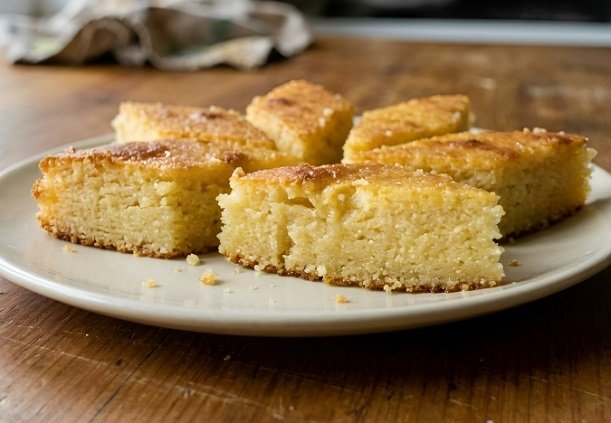
What Is Albanian Revani?
Revani is a cake that is soaked in sugar syrup after it comes out of the oven.
It belongs to a group of syrup-soaked sweets shared across lands that were once part of the Ottoman Empire, and similar cakes appear in Turkey, Greece (usually spelled ravani), the Balkans and parts of the Middle East.
In Albanian recipes the cake is typically cut into diamond shapes, and the syrup is called shurup or sherbet (also written shërbet).
Albanian-language recipe sites present it as a familiar home-baked sweet, one that sits alongside other syrup desserts such as baklava. For more of them, see this guide to Albanian desserts.
The history of the name is not settled. One account links it to Revan, the Ottoman name for Yerevan; another credits a 16th-century Ottoman poet called Revani.
Exactly when the cake entered Albanian kitchens is not clearly documented, so it is safer to call it a shared regional dessert than to give it a single origin.
What Makes Revani Different?
The defining feature is the soak. Unlike a cake finished with frosting, revani is baked plain, then saturated with syrup so that the crumb turns moist and glossy while keeping its shape.
Because the syrup does the sweetening, the batter itself needs little sugar.
The version here uses fine semolina with a small amount of wheat flour, plus yogurt and oil. Semolina gives the crumb a granular, slightly sandy texture and helps it hold syrup without collapsing.
That is one way to make it, not the only Albanian way. Published Albanian-language recipes also use cornmeal (miell misri) with wheat flour, and at least one Albanian home cook describes a family version built on flour and cornstarch with no semolina at all.
Syrups vary too: lemon is common, some use orange juice, and a few add honey or a little liqueur.
Ingredients
Syrup
- 500 ml (2 cups) water
- 360 g (1¾ cups) granulated sugar
- Peel of 1 lemon, in wide strips
- 2 tablespoons lemon juice
Cake
- 4 large eggs, at room temperature
- 170 g (¾ cup plus 1 tablespoon) sugar
- 250 g (1 cup) thick plain yogurt
- 120 ml (½ cup) sunflower oil or another mild-flavored cooking oil
- Zest of 1 lemon
- 1 teaspoon vanilla extract
- 240 g (about 1⅓ cups) fine semolina
- 100 g (¾ cup) all-purpose flour
- 10 g (2 teaspoons) baking powder
- 1 pinch salt
How to Make Albanian Revani
The order matters here: syrup first, then batter, then bake and soak.
Make the syrup
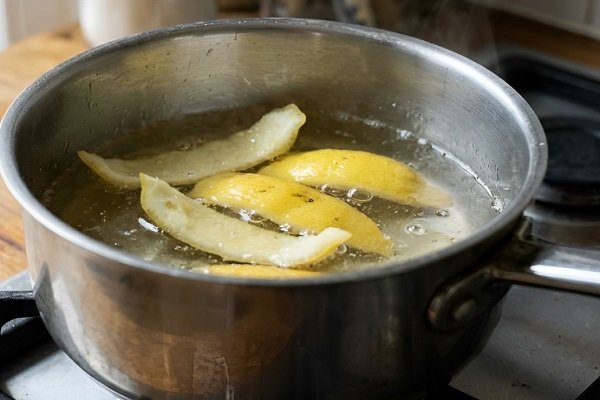
Simmer the water, sugar and lemon peel for 8 to 10 minutes. Stir in the lemon juice, remove the peel and set the pan aside to cool completely. It has to be cool by the time the cake comes out.
Heat the oven and prepare the pan
Set the oven to 180°C (350°F) and grease a 23 × 33 cm (9 × 13-inch) pan.
Whisk the eggs and sugar
Beat them for five to six minutes, until the mixture is pale, thick and leaves a visible trail. This step builds most of the cake’s lift.
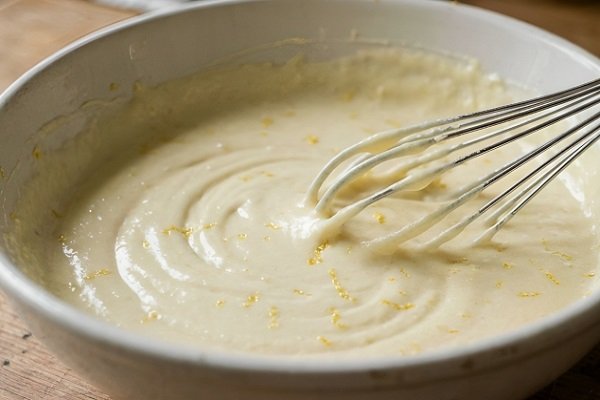
Add the wet ingredients
Stir in the yogurt, oil, lemon zest and vanilla until smooth.
Fold in the dry ingredients
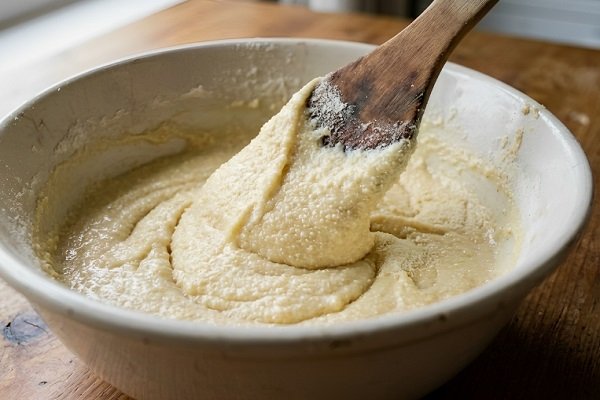
Mix the semolina, flour, baking powder and salt, then fold them in two additions, only until no dry patches remain. Let the batter stand for 10 to 15 minutes if you have time, so the semolina softens.
Bake
Pour the batter into the pan and bake until the top is deep golden and a skewer comes out clean (see the doneness cues below).
Cut while hot
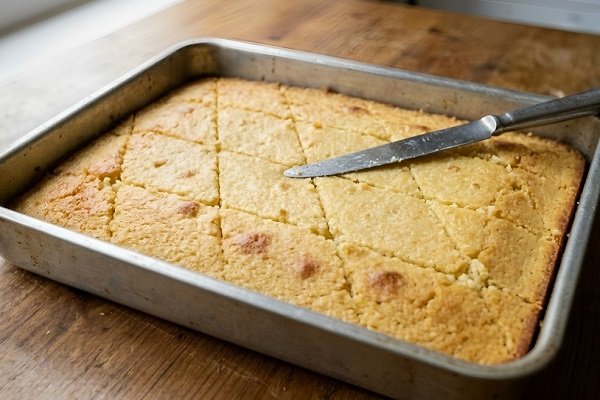
Straight from the oven, cut the cake into diamonds or squares, all the way to the bottom of the pan.
Soak
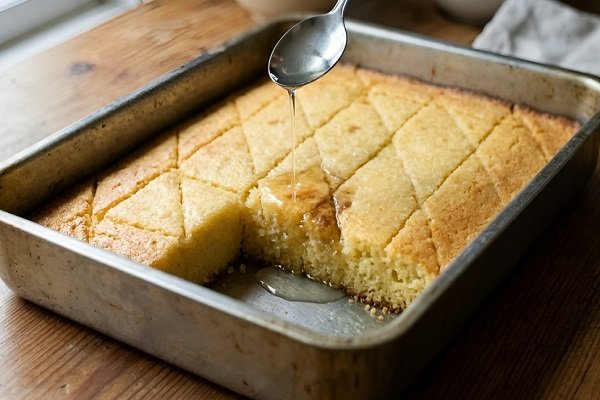
Spoon the cooled syrup over the hot cake in three or four additions, pausing between each so it can sink in.
Rest
Cover loosely and leave the pan for at least two hours, or overnight. The syrup spreads evenly and the pieces firm up.
How to Tell When Revani Is Done
Time is only a guide, because ovens and pans differ. Look for a top that is evenly golden brown, with edges that have started to pull away slightly from the pan.
Press the center lightly. It should spring back instead of leaving a dent. Insert a skewer into the center; it should come out without wet batter, with only a few dry crumbs clinging to it.
If the top browns well before the center is set, cover the pan loosely with foil and bake a little longer.
Getting the Syrup Right
The syrup should be thin, closer to a light sugar water than to honey. A syrup that has simmered too long thickens as it cools and sits on the surface instead of sinking in.
Published recipes disagree about temperatures. Some pour cool syrup over a hot cake, some pour warm syrup over a cooled one, and at least one Albanian-language recipe pours warm syrup over a hot cake in three or four portions.
What they share is slow, staged pouring. A temperature contrast between cake and syrup is the most commonly cited way to help absorption, and this recipe uses a hot cake with cool syrup.
Cutting the cake before soaking gives the syrup channels to follow into the center. Pour slowly, a few spoonfuls along each cut at a time, and stop when the cake no longer takes up liquid. A little syrup left in the pan is better than a soggy base.
Storage
Cover the pan or move the pieces to an airtight container. Because the cake contains eggs and yogurt and is soaked in a moist syrup, the refrigerator is the cautious choice, especially in warm weather or if the cake will sit for more than a day.
Under general food-safety guidance for leftovers, refrigerated cake is best eaten within three to four days. Let chilled pieces come back to room temperature before serving, since the crumb tastes softer when it is not cold.
Mistakes
The cake is dry
This usually happens when the cake is baked for too long or does not get enough syrup. Check for doneness early, and make sure the syrup actually reaches the center rather than running off the edges.
The cake is soggy or wet
Too much syrup, or a batter that was too loose, can leave the base waterlogged. Pour in stages and stop once the pieces stop absorbing.
The syrup will not soak in
Look at three things: the syrup went on too quickly, the syrup was boiled too long and thickened, or the cake was not cut before soaking. A temperature contrast between cake and syrup also helps, so check that too.
The center is underbaked
A pan that is too small makes the batter too deep, and an oven that runs hot browns the top before the middle sets. Use a pan close to the size in the recipe, and tent the cake with foil if it colors too quickly.
The texture is dense
Over-mixing after the dry ingredients go in, old baking powder, and under-whisked eggs are the likely culprits. Fold gently and keep the leavening fresh.

Rachel Bradley is a food writer and recipe developer with a love for home cooking and global flavors. She has spent years testing recipes in her kitchen, exploring everything from quick weeknight meals to traditional dishes from around the world. Her goal is simple — make great food accessible to everyone.