The Best Fluffy Pancakes recipe you will fall in love with. Full of tips and tricks to help you make the best pancakes.

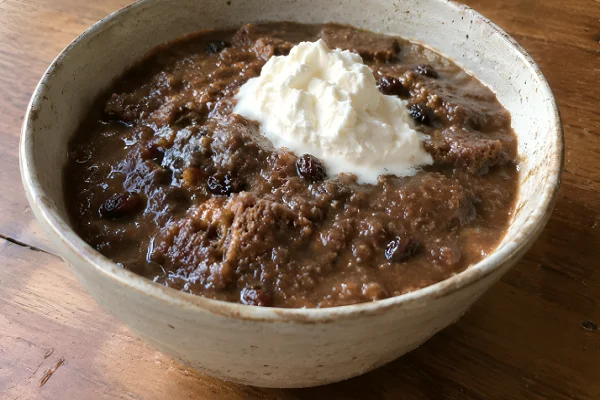
What Is Leivasupp?
Leivasupp means “bread soup” in Estonian. In Estonian cooking it is a dessert, not a starter or a main course. Estonian recipe sources describe it as a classic Estonian dessert.
The dish makes sense in a country where rye bread (rukkileib) accompanies almost every savoury meal. Leftover or hardened bread becomes the base of the soup rather than going to waste.
The soup is sweetened, lightly spiced and thickened by the bread itself, which is why it is often called a sweet bread soup or a rye bread dessert.
Bread soups exist elsewhere in northern Europe too, and they can be savoury or sweet. The Estonian one is defined by dark rye bread, raisins and a sour berry juice.
Ingredients
400 g dark rye bread (about 14 oz)
The bread is both the base and the thickener of the soup.
1.5 litres of water (about 6⅓ cups)
The water softens the bread and forms the body of the soup.
200 ml raisins, rinsed (about ¾–1 cup)
They add sweetness and soft, chewy pieces against the smooth bread purée.
85–130 g sugar (100–150 ml, roughly ½ cup)
Sugar balances the sourness of the rye and the juice. The range lets you adjust to taste.
1 cinnamon stick
It gives gentle warmth and is removed before serving. Some recipes use about ½ teaspoon of ground cinnamon instead.
200 ml cranberry or redcurrant juice (a scant cup)
The tart juice cuts through the sweetness. Other sour juices also appear in Estonian recipes.
Milk, sour cream or whipped cream, to serve (optional)
These are added at the table.
How to Make
Soak the Rye Bread
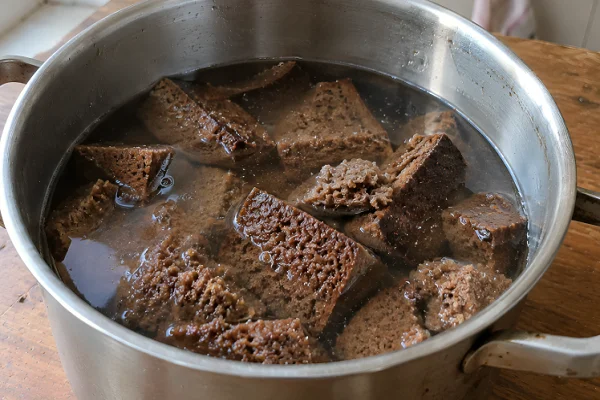
Tear or cut the bread into chunks and put it in a large pot. Pour in the 1.5 litres of water and leave it until the bread has softened.
Soaking times vary between cooks, and overnight soaking is only one option, not a requirement.
One Estonian home cook soaks the bread overnight and boils it the next morning, while other recipes soak it briefly or boil it straight away.
Cook Until the Bread Softens
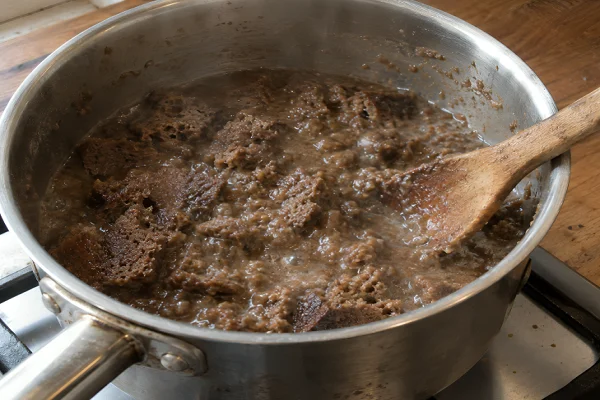
Put the bread back in the water and put the pot on the stove.
Bring it to the boil, then lower the heat and simmer, stirring from time to time so the bread does not catch on the bottom. The mixture can splutter, so keep the heat gentle.
Judge doneness by texture rather than the clock: the bread is ready when it has broken down into a soft, mushy mixture with no hard pieces left.
Press the Bread Through a Sieve
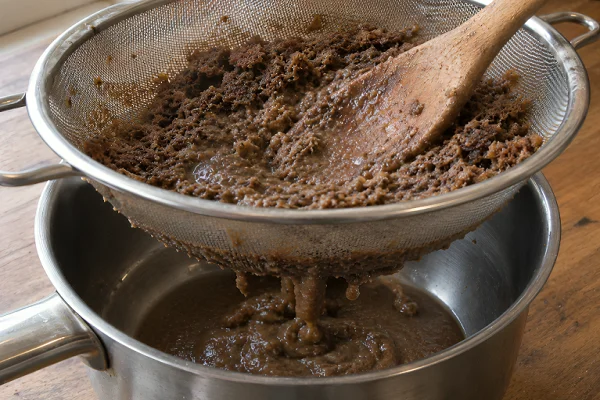
Mix it up and use the back of a spoon to push it through a fine sieve. Then, add the smooth purée back to the pot. Sieving gives the soup an even, silky texture. At this point, the mixture will look like a liquid.
Not every cook sieves. Some Estonian recipes simply stir the boiled bread into a mushy porridge, which gives a coarser soup.
Add Raisins, Sugar and Cinnamon
Stir in the rinsed raisins, the cinnamon stick and the sugar. Start with the lower amount, about 85 g. You can sweeten further once the juice is in.
Stir in the Berry Juice
Add the cranberry or redcurrant juice. Bring the soup slowly back to the boil and let it simmer for a few minutes. Estonian sources give a range from a couple of minutes to about five. Taste, then take the pot off the heat and remove the cinnamon stick.
Cool and Chill the Soup
Take the soup off the heat and let it cool, but do not leave it standing for long.
Food-safety guidance is to refrigerate leftovers within 2 hours of cooking, or within 1 hour in a room above about 32 °C (90 °F).
A large pot cools slowly, so divide the soup into shallow containers to speed things up. Eat it lukewarm, or cover it and refrigerate it until cold.
Finished leivasupp is a thick, creamy, spoonable purée with soft raisins throughout. Made with 1.5 litres of water, it comes out on the thin side while hot and firms up as it cools, so judge the texture once it is cold.
Tips
Choose the right rye bread
One Estonian recipe specifies a naturally leavened sourdough rye, which may contain caraway but not a mix of other seeds. Heavily seeded German-style rye slices are not recommended.
Outside Estonia, some recipes use dark pumpernickel as a substitute, though the taste will differ.
Use hard or stale bread when you can
The harder the bread, the thicker the soup tends to be. Some Estonian recipes also use fresh bread.
Adjust sweetness at the end
The sourness of the rye and the berry juice varies from loaf to loaf and brand to brand. Add sugar in small amounts after the juice goes in, then taste again.
Control the consistency
The 1.5 litres of water gives a fairly loose soup. The sources behind this recipe suggest about 1 litre of water for a thicker result, but that change has not been tested here, so treat it as an option to try rather than a guaranteed improvement.
If the soup turns out thicker than you like, stirring in a little water or milk is an untested but simple adjustment.
Keep it from getting too thick in the pot
Long simmering reduces the liquid, and the mixture turns dense. Keep the heat low, and add a splash more water if it tightens before the bread is soft (an untested adjustment).
Store it covered and cold
Keep leftover soup in covered containers in the refrigerator. There is no tested shelf life for leivasupp, so follow general food-safety guidance for leftovers, which is to eat refrigerated leftovers within 3 to 4 days.
If you serve it warm, reheat it to a rolling boil, stirring so it does not scorch, and discard anything that was left out for more than 2 hours.

Rachel Bradley is a food writer and recipe developer with a love for home cooking and global flavors. She has spent years testing recipes in her kitchen, exploring everything from quick weeknight meals to traditional dishes from around the world. Her goal is simple — make great food accessible to everyone.