The Best Fluffy Pancakes recipe you will fall in love with. Full of tips and tricks to help you make the best pancakes.

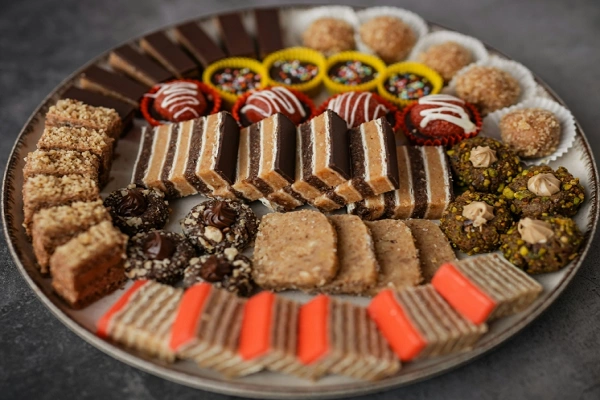
Nobody in Serbia makes one dessert at a time.
Walk into a Serbian kitchen three days before Christmas or a family slava, and you will find the counter already occupied. Tins cooling near the window. Walnut shells on the newspaper. A pot of syrup on the stove that has been reduced twice already.
This is not cooking for pleasure in the casual sense. You have to do this for the occasion, the visitors, and the person who taught you the recipe in the first place.
Serbian desserts cannot be separated from this context. They exist because of specific moments, specific relationships, and a food culture where arriving empty-handed at a celebration is simply not something that happens.
A Country Built at a Crossroads
Serbia spent centuries absorbing the habits of whoever governed it.
The Ottomans administered most of Serbian territory from the late fourteenth century until the early nineteenth. They left behind syrup-soaked pastries, the culture of the public pastry shop, and a taste for intense sweetness balanced with nuts.
The Austro-Hungarians, who governed the northern province of Vojvodina for an extended period, brought layered cream cakes, strudel dough, and a Central European approach to baking that is still visible there today.
What is interesting is that Serbs absorbed both without treating either as foreign. Walk into any poslastičarnica, a Serbian pastry shop and you will find baklava next to cream tortes. No one finds this unusual.
Slatko: Before the Meal, Before Everything
The oldest Serbian sweet tradition is not a cake. It is a spoonful.
Slatko is a fruit preserve unlike any other. While jam breaks fruit down, slatko keeps each piece whole suspended in thick, clear syrup, recognizable as what it was. Quince, sour cherry, fig, green walnut almost any fruit works.
One of the rarest varieties uses May rose petals, chosen specifically for scent, simmered with lemon juice until they turn translucent.
It is not served after a meal. The first thing a guest receives at the door is a small crystal bowl, a spoon, a glass of cold water alongside.
This welcome ritual appears in Serbian ethnographic records going back hundreds of years. In villages, it still happens exactly this way.
Some traditions survive urbanization. This one has.
What the Ottomans Left in the Kitchen
Baklava has been part of Serbian cuisine for centuries and is now considered a traditional sweet rather than a foreign import. It arrived centuries ago and stayed so completely that the question of origin rarely comes up.
The Serbian version uses walnuts not pistachios packed between thin phyllo sheets and soaked in lemon-flavored sugar syrup after baking.
While still warm, it is served in diamond forms. You will find it in every pastry shop in the country, in every season, without any particular occasion required.
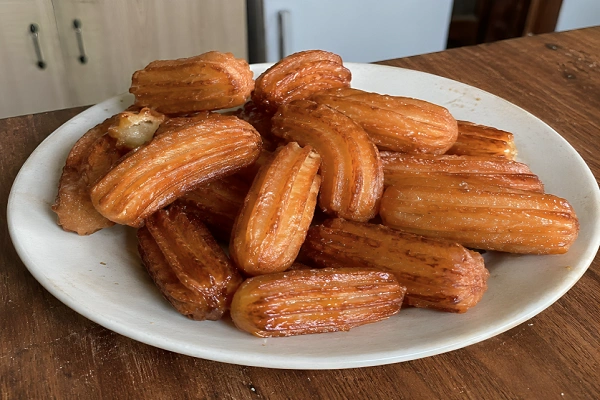
Tulumbe came through the same route. Fried cylinders of dough, soaked through with syrup until the sweetness reaches the center.
They are heavier than they look. One or two is usually enough, which is something most people only learn after eating four.
The North Bakes Differently
Vojvodina feels different from the rest of Serbia, and the dessert table reflects it.
Strudel locally called štrudla is deeply embedded here. Apple, sour cherry, and poppy seed fillings are the standard. The poppy seed version is a Christmas tradition in this region specifically, made in long rolls, sliced cold the next morning with coffee.
Šnenokle is another dessert that has been so thoroughly adopted that most Serbs do not think of it as foreign. The dish originated in France, where it is known as île flottante meringue floating in vanilla custard.
It traveled through Austria, where it became known as Schneenockerln, and from there entered Vojvodina during the Austro-Hungarian period. The Serbian name šnenokle is a phonetic borrowing from the Austrian-German version of the name.
It is a common household dessert today, made without any special occasion required, and is one of the few Serbian sweets that carries no ceremonial weight.
The Cakes That Cannot Be Skipped
Two cakes appear at Serbian celebrations so consistently that their absence would be noticed.
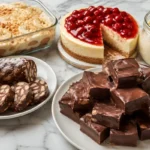
Reforma torta is layers of walnut sponge and chocolate cream, finished with a chocolate glaze and crushed walnuts pressed into the top. It has stayed in Serbian homes since the end of World War II.
Every family makes it slightly differently, some prefer a bitter glaze, others sweeter cream but the silhouette is always recognizable.
At a Serbian wedding or birthday, reforma simply appears. It is so common at celebrations that many families automatically include it in the dessert table.
Vasina torta has a more precise documented origin. The recipe dates back to 1908 in the town of Paraćin in central Serbia. When Vasa Čokrljan’s wife Jelena faced a dangerous pregnancy, he sold his possessions and took her to Vienna for medical treatment.
Both mother and child survived. In gratitude, Jelena’s mother prepared a special cake for her son-in-law and named it after him.
The cake combines a walnut and almond sponge with a chocolate cream filling flavored with orange juice, oranges being a notable ingredient at the time, as they were an imported luxury in early twentieth-century Serbia. Paraćin pastry shops still make it today.
Sitni Kolači: The Small Cookies That Matter Most
At a Serbian slava or Christmas gathering, the sweet table is not built around one large centerpiece. It is built around sitni kolači small cookies, plural, always several varieties at once.
Vanilice are the most expected. Two small walnut biscuits pressed together with apricot or rose-hip jam, then rolled in vanilla sugar. Simple ingredients.
The recipe in most households has no written measurements flour and walnuts and fat combined by feel, the way it has always been done. They are made in large batches before Christmas and kept in tins, where they improve over a few days as the jam softens the biscuit slightly.
Bajadera is the other constant. A no-bake block of ground walnuts or hazelnuts, sugar, and chocolate pressed flat, chilled, cut into small squares. Dense. Intensely sweet. One or two pieces is the correct amount, which is advice most people ignore the first time.
Orasnice are older and easier than either of these. Walnut, egg white, sugar. No flour. The biscuits come out crisp at the edge and chewy inside, with a walnut flavor that nothing softens or masks. Making a single batch requires nearly half a kilogram of walnuts.
This is why they are considered a real effort. And why, when someone makes them for you, it means something.
The Dumpling That Confused Everyone
Gomboce are difficult to classify.
They are potato dough dumplings with entire plums within. They are boiled until they are done, then rolled in breadcrumbs that have been fried in butter and sugar.
Served hot. Often served as a light meal or main sweet dish, not at the end of one especially in autumn when plums are at their best.
They are most common in Vojvodina. Their closest relatives are Hungarian and Austrian plum dumplings. In Serbia, this comparison is acknowledged without much interest. Gomboce are gomboce. That is enough.
The Wheat Dish That Is Not Optional
Žito sits in a different category from everything else on this list.
Boiled whole wheat grains are mixed with sugar and walnuts, and sometimes decorated with a cross pattern on top.
Prepared specifically for slava, it is blessed by a priest before the celebration begins. It is traditionally eaten first before any other food, the main meal, and even the sweets table.
Žito is not dessert in the casual sense. It carries Orthodox Christian symbolism tied to resurrection and continuity.
Calling it a sweet undersells what it represents. But it belongs in any honest account of what Serbs eat on their most significant occasions because without it, the slava has not properly begun.
Why These Recipes Survived
The Serbian desserts that are still being made today were not preserved in cookbooks.
They survived because someone made them often enough, in enough kitchens, that they became part of the rhythm of the year. Vanilice before Christmas. Reforma at the birthday. Slatko at the door. Žito before anything else.
The recipes exist in hands, not pages. Passed through watching, not reading. And that more than Ottoman syrup or Austro-Hungarian sponge is what makes the Serbian sweet table what it is.

James Carter is a food researcher and writer passionate about global cuisines, street food, and the stories behind what we eat. He combines thorough research with a genuine love for food culture to bring readers accurate, well-written, and interesting content.