The Best Fluffy Pancakes recipe you will fall in love with. Full of tips and tricks to help you make the best pancakes.

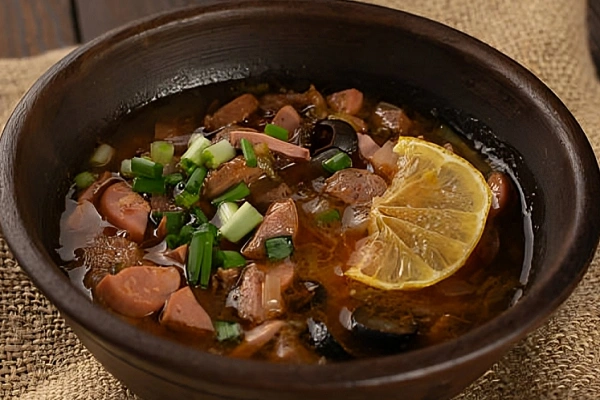
If you have ever tried solyanka, you know it is not an ordinary soup. It is thick, tangy, slightly smoky, and built on layers of meat or fish. Everything about it is bold and deeply flavorful. This guide explains the solyanka recipe in detail, including its history, ingredients, preparation method, and variations.
What Is Solyanka?
Solyanka (also spelled soljanka) is a traditional thick and sour soup from Russia. It is also common in Ukraine, Belarus, the Baltic states, and several other Eastern European regions. The dish exists in three main forms: meat solyanka (myasnaya), fish solyanka (rybnaya), and mushroom solyanka (gribnaya). Among these, the meat version is the most widely prepared and recognized.
Brief History
Early references to a dish called selyanka go back to the 17th century. At that time, it was not a soup but a hot dish made with cabbage, salted cucumbers, and different types of meat or fish.
One of the earliest written recipes appears in Nikolai Osipov’s 1794 book Ancient Russian Housewives, Housekeepers and Troublemakers, where it is still described as a main dish rather than a soup. Even in 1822, official Russian dictionaries defined solyanka as a main course.
The soup version developed later in the 1830s. Chef Gerasim Stepanov documented a selyanka soup recipe in 1834. By the 1840s, it was increasingly recognized as a soup, and cookbooks such as Yekaterina Avdeyeva’s 1842 book The Handbook of an Experienced Russian Hostess included mushroom versions.
Over time, ingredients like olives, capers, tomatoes, and pickle brine were added, shaping the modern version known today.
The Name: Origin
The name originally comes from selyanka, derived from selyanin, meaning “villager.” This referred to a simple rural dish. Later, due to its salty character, the name evolved into solyanka, linked to the Russian word sol meaning salt.
Both origins are historically referenced, and the modern name reflects this evolution.
Key Characteristics of Solyanka
A traditional solyanka recipe is defined by a few essential elements:
Multiple proteins: usually a mix of smoked, boiled, and cured meats or fish
Pickled cucumbers: essential for sourness and texture
Pickle brine: added directly to the broth for depth
Tomato base: cooked onions and tomato paste or tomatoes
Olives or capers: for saltiness and complexity
Sour cream and lemon: added at serving for balance
Solyanka Recipe: Meat Version (Classic)
Ingredients (serves 6)
Beef (bone-in) 600 to 700g
Smoked sausage 200g
Ham or cooked pork 150g
Frankfurters 150g
Brined cucumbers 3 to 4 medium
Pickle brine 100 to 150ml
Onion 2 large
Tomato paste 3 tablespoons
Olives 80 to 100g
Capers (optional) 1 tablespoon
Bay leaves 2
Black peppercorns 5 to 6
Oil or butter 2 tablespoons
Lemon 1
Sour cream to serve
Fresh dill or parsley for garnish
Step-by-Step Instructions
- Prepare the broth. Place beef in a large pot with 2.5 liters of cold water. Bring to a boil, remove foam, then add bay leaves and peppercorns. For one and a half to two hours, until soft. Remove meat, cut into pieces, and strain the broth.
- Prepare cucumbers Cut brined cucumbers into small cubes or strips. Simmer them in a small pot with 100ml pickle brine and 100ml water for 10,12 minutes. This softens the texture and balances sharpness.
- Cook onion base Heat oil or butter in a pan. Add onions and cook until soft. Add tomato paste and cook for 4,5 minutes until it becomes darker and aromatic.
- Prepare meats Slice all meats into small uniform pieces so each spoon contains a balanced mix.
- Combine everything and add broth back to the pot. Add tomato-onion mixture, cucumbers with liquid, meats, beef pieces, and olives. Stir well.
- Adjust taste before adding salt. Due to olives, brine, and smoked meats, additional salt is often not needed. Adjust sourness using pickle brine if required.
- Simmer Let everything simmer for 15,20 minutes on low heat so flavors combine properly.
- Serve Serve hot with a slice of lemon and a spoon of sour cream. Garnish with dill or parsley.
Fish Solyanka
Fish solyanka is typically made by combining different types of fish, such as white fish, salmon, or smoked varieties, with fish bones often used to create a rich, flavorful broth.
The same cucumber, brine, and tomato base is used. Cooking time is shorter, usually 10,15 minutes after broth preparation.
Mushroom Solyanka
This vegetarian version uses dried mushrooms like porcini. The mushrooms are soaked and used to create a rich broth.
The rest of the ingredients remain similar, including cucumbers, tomato base, and brine. It’s very common when people are fasting.
Common Mistakes
Using vinegar pickles instead of brined cucumbers
Skipping cucumber simmering step
Using only one type of meat
Adding salt too early
Not serving with lemon
Serving Suggestions
Solyanka is usually served with rye bread and sour cream. It is already a complete meal and does not require side dishes.
Storage
It can be kept in the fridge for three to four days. The flavor improves after one day. Warm it up slowly over low heat so it doesn’t boil. Add lemon and sour cream only when serving.
Nutritional Notes
Solyanka is high in protein due to mixed meats. It is also high in sodium due to pickles, brine, and cured ingredients. Tomato and onion provide antioxidants, while fats come mainly from meats and olive oil.
Why Solyanka Is Special
Solyanka stands out because of its combination of smoke, salt, acid, and richness. The use of pickled cucumbers and brine gives it a flavor profile that cannot be replaced by vinegar or lemon alone.
Historically, it was also a practical dish made from leftover meats, which is why it uses multiple protein types. Over time, it became a classic in Russian and Eastern European cuisine.
Interesting Fact
In Russian, the word solyanka is also used informally to describe a mixture of different things combined together a reference to the soup’s original style of mixing various ingredients.

James Carter is a food researcher and writer passionate about global cuisines, street food, and the stories behind what we eat. He combines thorough research with a genuine love for food culture to bring readers accurate, well-written, and interesting content.