The Best Fluffy Pancakes recipe you will fall in love with. Full of tips and tricks to help you make the best pancakes.

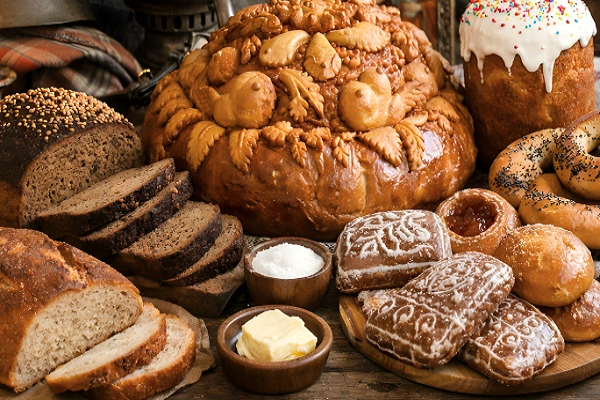
What makes Russian bread so different from everything else?
Russian breads are known for their deep history, rich flavors, and strong cultural importance.
Walk into any Russian home during a meal and the first thing you notice is bread on the table. Not as a side. Not as an afterthought. Right at the center because in Russian culture, it genuinely belongs there.
The difference starts with rye. Most of the world built its bread tradition around wheat, but Russia built it around rye, a grain that thrives in cold, punishing soil. It cost a lot to grow wheat and was hard to get. Rye was reliable. So for centuries, dark rye bread was what most Russians ate, not by choice but by geography.
Rye bread also carries real nutritional weight more iron, magnesium, and potassium than standard white wheat bread. Russians were eating a more nutritious loaf long before anyone used that word for marketing.
Then there is the cultural side. There is an old Russian proverb “Khleb vsemu golova” : bread is the head of everything. Guests have been welcomed with bread and salt for centuries. Wasting bread is still considered bad luck in many Russian households, a habit that traces back to times of war and famine when bread was genuinely all there was.
1. Borodinsky Bread A Classic Russian Bread
Dark. Dense. Faintly sweet. Slightly spiced. There is nothing quite like Borodinsky anywhere else in the bread world.
The recipe calls for at least 80% whole-grain rye flour, about 15% wheat flour, and around 5% rye or barley malt. Beet molasses goes in for that deep color. Coriander and caraway seeds give it the unmistakable aroma.
Bite into a fresh slice and you get three things at once the sourness of rye fermentation, the warmth of coriander, and a faint background sweetness from the molasses. The crumb stays surprisingly moist, which is why it works so well for open-faced sandwiches.
Behind the name sits one of Russia’s more haunting stories. At the Battle of Borodino, General Alexander Tuchkov was killed. His widow, Margarita Tuchkova, later built a convent on that same battlefield.
The nuns began baking this bread for mourning ceremonies, the dark color representing grief, the round coriander seeds representing grapeshot. Historians note that no documents confirm this legend before the 1920s, but the story has stuck for a reason.
The standardized recipe was set in 1933 and has barely changed since. Most Russians eat it simply with a thick slice, real butter, and a pinch of salt.
2. Darnitsky The Bread That Runs Russian Daily Life
Borodinsky gets the fame. Darnitsky does the work.
This is the bread that sat in every Soviet-era store and still shows up on most Russian tables today. Developed in 1930s Leningrad, it uses roughly 60% rye flour and 40% wheat flour, fermented with a sourdough starter. No spices. No sweeteners. Just flour, water, salt, and time.
The flavor is clean and mildly sour. The crumb is slightly springy. The crust smells good when fresh. It is not trying to impress anyone, that is exactly the point.
One detail that says a lot about Russian baking: the original recipe specifies not to use the finest quality flour. Overly refined flour makes it too soft and kills the texture. A bread that gets better with slightly rougher ingredients is a very specific kind of cultural object.
3. Karavai This Is Not Bread. This Is a Ceremony.
Some things look like food but function as something else entirely. Karavai is one of those things.
Round, large, and so elaborately decorated it feels almost wrong to eat it. Karavai has been at the center of Russian weddings since ancient times. The shape is deliberately circular, rooted in pre-Christian Slavic traditions where round forms represented the sun: life, harvest, and divine blessing.
Traditionally, it was made at the bride’s home by a group of married women, always in odd numbers, usually seven. They sang traditional songs throughout the entire baking process. The decorations were not random: two dough birds for the couple, other birds for family, and sprigs of periwinkle woven in as a symbol of love and purity.
At the wedding, the bride and groom each take a piece, dip it in salt, and eat it as a blessing. The rest is shared with every guest. Karavai also appears at formal welcome ceremonies where the honored guest arrives, and is greeted with a loaf on an embroidered cloth, a dish of salt resting on top. One bite. The gesture says everything.
4. Kalach What People Ate When They Could Not Stop to Wash Their Hands
Medieval Russian markets were busy and loud. Kalach was built for exactly that environment.
It is a white wheat bread already unusual, since white flour was expensive. The shape is a circle, but deliberately uneven: one part thick and doughy, the other much thinner. That thinner part is the handle.
Workers picked it up by the handle, ate without touching the part going into their mouth, then threw the handle on the ground. Poor people ate the discarded handles. From that habit came one of the most enduring phrases in Russian: “doyti do ruchki” to go down to the handle meaning to hit absolute rock bottom.
The most famous varieties came from Moscow and from Murom in the Vladimir region. And one more detail worth knowing: the surname Kalashnikov — including that of rifle designer Mikhail Kalashnikov literally means “son of a kalach maker.” The man who designed the world’s most produced rifle descended from someone who baked bread.
5. Kulich Russian Easter Bread
There is exactly one time of year to eat kulich: Easter.
In Russian Orthodox culture, Easter is the most important celebration on the calendar more significant than Christmas. Kulich is inseparable from it.
The dough is rich: eggs, butter, milk, sugar, yeast, raisins, and candied fruit all go in. The top gets a thick white glaze and colorful sprinkles. The shape is tall and cylindrical, which mirrors the form of artos, a ceremonial bread used in Russian Orthodox church services.
After the Easter service, families carry kulich to church in a decorated basket to be blessed by the priest. The texture is soft and pillowy, closer to a brioche than to any dark rye bread. Once a year, Russian baking goes somewhere completely different.
6. Zavarnoy The Oldest Method, Still Working
How do you make bread sweeter without adding any sugar?
Russian monastery bakers figured this out centuries ago. The technique is called zavarnoy from the word zavarka, meaning to scald. Near-boiling water is poured directly onto a portion of rye flour before anything else happens. The heat breaks down the starch and releases natural sugars already present in the grain.No sweetener is needed.
There is also no use of commercial yeast or a sourdough starter. The zavarka process handles everything. The method was developed in Russian Orthodox monasteries, where monks baked daily for centuries.
One practical result of this technique: zavarnoy stays fresh considerably longer than almost any other bread without preservatives. For a monastery feeding people through long winters, that was everything.
The flavor is earthy, mildly sweet, and dense but soft. As far from Borodinsky’s sourness as Russian bread gets.
7. Bublik Simple, and Always Better With Tea
At first glance, bublik looks like a bagel. Ring-shaped, shiny outside, poppy or sesame seeds on top. The resemblance is real, both are boiled before baking, which creates that glazed exterior and tender interior.
But bublik dough has more sugar and fat than a bagel. The result is softer, slightly sweeter, and less chewy.
This is not bread for a formal meal. It is the bread you pick up from a street vendor, eat with one hand while walking, with a hot glass of tea in the other. That combination of bublik and tea has been a constant of Russian street culture for generations.
8. Pryanik Russian Honey Bread
Pryanik is the oldest item on this list and the hardest to categorize. Somewhere between bread, cookie, and cake denser than cake, softer than a biscuit.
It first appeared in Russia in the 9th century, originally called medovy khleb honey bread. The recipe was simple: rye flour, honey, and berry juice. Nothing else.
By the 12th and 13th centuries, spice trade routes with India and the Middle East changed everything. Cinnamon, cardamom, ginger, and cloves started going in. By the 17th century, spiced honey bread had become so standard that the name shifted entirely; pryanik comes from pryanost, the Russian word for spices.
Today it comes pressed into decorative molds, stamped with patterns, or cut into shapes. Plain or filled with jam, honey, or condensed milk. Almost always finished with a sugar glaze.
The most famous version comes from Tula, south of Moscow. Historical records trace the Tula pryanik to 1685. The city has been associated with this bread for so long that today it has both a museum and a monument dedicated to it.
What did bread mean to Russia during the war?
It’s not simple to answer this.
During the Siege of Leningrad in World War II, the blockade lasted 872 days. At its lowest point in November and December of 1941 non-working civilians, children, and the elderly received 125 grams of bread per day. Workers received 250 grams.
That was not a supplement to other food. That was everything.
Hundreds of thousands died. The ones who survived did not forget what those grams felt like. They passed that memory down.
This is why older Russian generations avoid throwing bread away. It also explains why bread remains at the center of the table.
For the same reason, the tradition of “bread and salt” still carries genuine warmth when offered to a guest. That meaning was earned not inherited from tradition, but lived through.
Final Thoughts
Eight breads. More than a thousand years of history. Monasteries, battlefields, medieval markets, royal courts, wedding tables, church blessings, and siege rations Russian bread has passed through all of it.
None of these breads are the same. Different flour, different technique, different occasion, different taste. What connects them cannot be measured in a recipe.
In Russia, bread has never been just food. It has been the thing people held onto when everything else was gone. That is a difficult idea to carry in a loaf of bread and Russian bakers have somehow been doing it for centuries.

Rachel Bradley is a food writer and recipe developer with a love for home cooking and global flavors. She has spent years testing recipes in her kitchen, exploring everything from quick weeknight meals to traditional dishes from around the world. Her goal is simple — make great food accessible to everyone.