The Best Fluffy Pancakes recipe you will fall in love with. Full of tips and tricks to help you make the best pancakes.

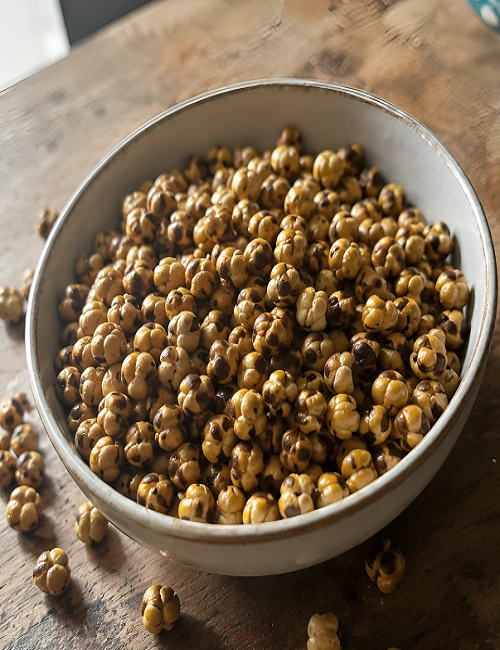
Leblbi offers a dry, satisfying crunch and a subtle, nutty flavor that’s enjoyable on its own. It’s a roasted chickpea snack, and it’s been part of Turkish daily life for centuries. What most people don’t realize is how much work goes into that one bite. Producers spend weeks sorting, soaking, resting, and roasting the chickpeas before any of it reaches a market stall.
What Is Leblebi?
Leblebi is a traditional snack consisting of roasted chickpeas. It has a firm bite and a mild, nutty taste, and it shows up on tables across Turkey, Greece, Iran, and much of the wider Middle East. Some people eat it completely plain. Others prefer it salted, spiced, or coated in a thin layer of sugar.
The name has a curious backstory. It probably traces back to the Arabic word “leblab,” which refers to the Lablab plant and its edible beans. So in a roundabout way, “leblebi” simply means something made from leblab.
Where Leblebi Comes From
This is not a new snack by any stretch, though its exact age is genuinely disputed. Some accounts trace chickpea roasting in the region back to around 1000–1300 CE, while others argue the snack as we know it today only emerged in the 17th century.
No single source settles the question, and Turkish culinary historians themselves note that there’s no firm agreement on when or by whom leblebi was first made.
What’s clear is that from wherever it started, it traveled. Roasted chickpeas made their way into North Africa, the Middle East, Europe, and parts of Asia over the following centuries.
It became known by different names and varied slightly from region to region. Iranians eat it. So do people across Central Asia and the Middle East. Greeks call their version “stragalia.”
Even in Sicily, roasted chickpeas turn up as a local snack. One idea, take a chickpea and roast it, ended up looking a little different everywhere it landed.
Çorum: The Heart of Leblebi Production
If one city gets credit for leblebi, it’s Çorum, in central Turkey. Local stories say Ahmedi Sever was the first to make it in the area, but this is based on tradition, not solid historical evidence.
Some even believe Sever and Şeyh Murat Gazi, who others credit with creating the sugared version, might actually be the same individual.
What’s better documented is more recent: Çorum-style leblebi production has been going for roughly three centuries, long enough that the city’s name became shorthand for the snack itself.
That reputation is now legally official. On December 10, 2002, the Turkish Patent and Trademark Office (Türk Patent) formally recognized Çorum leblebisi, a type of roasted chickpea, as the first leblebi in Turkey to acquire geographic indication registration.
Kütahya’s Tavşanlı leblebi followed, registered on 6 September 2004, and Denizli’s Serinhisar leblebi received its registration in 2009. More recently, Konya’s Seydişehir leblebi joined the list, registered in 2023.
In practice, this registration means only chickpeas processed in these specific places, using their traditional methods, can legally carry these regional names.
How Leblebi Is Made
Nothing about making leblebi is quick, and that slowness is the whole point. It starts with selection. Producers look for chickpeas with the right shape, size, and color, and harvest timing matters too, since it affects how the finished product turns out.
The preferred variety is usually Kabuli chickpeas: large, light-colored, round, and smooth, with a hull that comes off easily.
From there, the process runs through several stages.
Cleaning and grading comes first. Chickpeas get sorted by size and quality before anything else happens.

Tempering follows. The chickpeas are heated to roughly 85–90°C for 10 to 15 minutes, which lets moisture work its way into the seed.
Resting is the longest step by far. The chickpeas sit for close to 30 days at room temperature, usually packed into jute bags. A lot of the flavor and texture actually develops here, not during the roasting itself.

First roasting loosens and strips away the outer shells. At this point, the product is called “single roasted leblebi,” not quite finished yet.
Final roasting happens about two days later. This step gets the chickpeas ready to sell.

Add it all up and you’re looking at about a month and a half from raw chickpea to finished product. Few snack foods take that long to make.

Types of Leblebi
Not all leblebi is the same. Depending on how the chickpeas are hulled and how many times they’re roasted, you end up with fairly different products.

Sarı Leblebi (Yellow Leblebi) is the dehulled version, sometimes called “Girit leblebi” after Crete. Roughly 95% of the hulls get removed during processing.
Beyaz Leblebi (White Leblebi) keeps its hull. It’s also just called “nohut,” the Turkish word for chickpea. Because the hull stays on, it has a white exterior, a beige-to-white interior, and a firmer texture than the yellow version. The type most closely linked to the geographical indicator of Çorum is single-roasted.
Çifte Kavrulmuş Leblebi (Double-Roasted Leblebi) goes through a second roasting round, which leaves it with a yellow base and black speckles.
Leblebi Şekeri (Sugared Leblebi) wraps roasted chickpeas in a thin sugar coating. Its origins reportedly go back to around 1370, credited to a figure known as Şeyh Murat Gazi, and it’s still strongly associated with Çorum today.
Beyond these core varieties, Turkish producers make close to 40 different types in all: salted, spicy, honey-coated, poppy-seed, sesame, and even chocolate or fruit-flavored versions sold in shops and market stalls.
Leblebi Nutrition: What’s Actually in It
Since leblebi is just roasted chickpeas with most of the moisture gone, its nutrition profile follows chickpeas closely, just more concentrated per gram.
Plain boiled chickpeas come in at around 164 calories, 8.86 grams of protein, and 7.6 grams of fiber per 100 grams, based on USDA FoodData Central figures. They have a low glycemic index of about 28, far lower than rice, bread or potatoes.
Roasting changes the math a bit. Removing water concentrates everything else, so roasted chickpeas typically show up with more protein and more fiber per 100 grams than the boiled version. Estimates commonly land in the high-teens to low-20s for protein, with fiber even higher.
Exact numbers shift depending on the roasting method and how much oil or salt gets added, so checking the label on a specific product remains the most reliable way to know what’s actually inside it.
How People Eat Leblebi
There’s no single “right” way to eat it. Some common ones:
- Straight from the bowl, the way you’d snack on nuts.
- Alongside tea or coffee, a classic pairing in Turkish homes and tea houses.
- Sprinkled over salads or yogurt dishes for extra texture.
- Passed around at gatherings, since it keeps well and doesn’t need refrigeration.
One underrated advantage: leblebi doesn’t spoil quickly. Stored properly in an airtight container, it holds up for weeks, longer than most fresh-roasted nuts manage.
A Note on Tunisian “Lablabi”
Worth flagging: in Tunisia, the word “leblebi” (often written “lablabi”) means something else entirely. There, it’s a warm breakfast soup made with chickpeas, eggs, and bread, nothing like the Turkish snack. If you’re searching online, it helps to know these two dishes only share a name and an ingredient, not much else.
Leblebi in Culture
Leblebi even made its way into 19th-century opera. In 1875 the Ottoman-Armenian composer Tigran Chukhajian (1837-1898) produced an opera, Leblebidji Hor-Hor Agha (The Chickpea Vendor). A chickpea seller who inspired a whole opera speaks something about how the common street vendors were part of the texture of city life back then.
Final Thoughts
Leblebi isn’t really “just” roasted chickpeas, not once you know what goes into it. Weeks of resting. Careful roasting. Regional pride going back centuries. It has lasted from 14th-century Turkey to modern snack shelves for one simple reason: a good idea, handled patiently, tends to hold up.
FAQs
Is leblebi the same as regular roasted chickpeas?
Not exactly. Leblebi follows a specific Turkish process built around weeks of tempering and resting before roasting. Roasted chickpeas made elsewhere often skip most of that and use a quicker method.
Is leblebi healthy?
The same key strengths as chickpeas in general: protein, fibre, a low glycemic index. Plain or lightly salted versions are the better choice; sugar-coated or heavily oiled ones work fine as an occasional treat.
How long does leblebi stay fresh?
Kept airtight and away from moisture, it usually stays crisp for several weeks, sometimes a few months.
Where does the best leblebi come from?
Çorum is generally seen as leblebi’s traditional home and was the first to receive official geographic indication status, in 2002. Kütahya’s Tavşanlı, Denizli’s Serinhisar, and more recently Konya’s Seydişehir also produce well-regarded, officially registered regional varieties.

James Carter is a food researcher and writer passionate about global cuisines, street food, and the stories behind what we eat. He combines thorough research with a genuine love for food culture to bring readers accurate, well-written, and interesting content.